 THE INTERNATIONAL SHOOTO COMMISSION (ISC)
 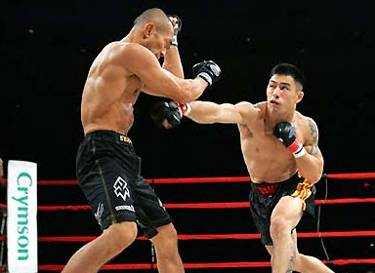 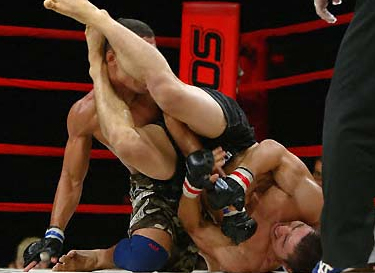 THE HISTORY OF SHOOTO & THE I.S.C. The term “Shooto” is derived from the Japanese words “shu” and “to,” which taken together mean “learned combat.” Sometimes referred to as “Shootfighting” in the Western World, the art of Shooto is a comprehensive fighting style founded by Master Sotoru Sayama in Japan during the early 1980’s. A life-long practitioner of the Martial Arts, Sensei Sayama drew from his background in judo, karate, sambo, muay thai, and submission wrestling to create a comprehensive fighting system made up of the most effective techniques taken from these core martial arts disciplines. Master Sayama sought not only to establish Shooto as a recognized fighting system, but also as an organized form of martial arts competition. In 1986, after founding the International Shooto Commission to oversee mixed martial arts competition, Master Sayama sanctioned the first amateur Shooto event. From these humble beginnings, the Shooto organization quickly spread throughout Japan and has now become the primary sanctioning body for Japanese mixed martial arts competition. The spread of Shooto across the sea to the United States is credited to Yorinaga Nakamura, Master Sayama’s student and the first ever Shooto World Champion. With the help of American martial arts legend, Dan Inosanto, Nakamura founded the first American Shooto school in Los Angeles, California at the Inosanto Academy of Martial Arts. Shooto competition spread rapidly throughout the United States and events are now held regularly in Hawaii, Nevada, Indiana, Illinois, and Tennessee, with affiliates currently working to develop Shooto in Colorado and in Florida as well. Worldwide, the International Shooto Commission oversees competitions held in Australia, Holland, Finland, Latavia, Norway, Switzerland, Lithuania, Denmark, Canada, and Brazil, in addition to the many events featured regularly in Japan. Established in the mid 1980’s, the International Shooto Commission is by far the oldest mixed martial arts organization in the world, predating the Ultimate Fighting Championship (UFC) by nearly 10 years. With over 70 events sanctioned annually througout the world, the ISC has also grown to become the world’s largest Mixed Martial Arts organization. Furthermore, the ISC is the only true, non-political, international sanctioning body which oversees Mixed Martial Arts competition throughout the world, offering the only legitimate world title which must be earned through competition against officially ranked opponents in regional divisions before a formal title bout is offered. Other commercially driven organizations crown so-called "World Champions" without the due process of facing international competition to rise through a legitimate ranking system. Such titles are not merit-based, but manufactured for purposes of commercial marketing and financial gain. This is not the Shooto way. OFFICIAL SHOOTO RULES (NOTE: This is an abbreviated version of the rules. The full 16 page document may be downloaded by clicking here.) The Ironheart Crown is a legitimate martial arts competition sanctioned by the U.S. Shooto Association, a division of Japan's World Shooto Organization. Rules and regulations governing fights and event production are held in strict accordance with Shooto's requirements. All event productions are overseen by the International Shooto Commission's U.S. representative, Rich Santoro. The following is an abreviated outline of the rules governing Shooto competition. This is a summary of the International Shooto Commission's sixteen page rules document. EQUIPMENT AND
RING ATTIRE: (2) Official Shooto gloves - The laces or straps of the gloves must covered with self-adhesive tape (3) Boxing or kickboxing trunks, full length tights or athletic shorts (4) Men may not wear top apparel, women shall wear a short sleeve or sleeveless athletic top (5) No foot wear or nasal strips (6) Competitors may wear approved knee pads, or joint sleeves made of nylon or similar material (7) Hands and ankle wraps must be no more than 1/4 inch thick and approved by the supervisor (8) Hair must be trimmed and/or pulled back (9) Finger nails and toe nails must be properly trimmed (10) Competitors should be neatly shaven with no abrasive facial hair (11) Hair styling products and cosmetics must be thoroughly washed off (12) No greases, oils or similar substances may be worn (13) No metal, plastic or abrasive materials including jewelry may be worn WEIGHT CLASSIFICATIONS: (2) The weight
classes and their maximum allowable weights are as follows: CORNERMEN: (2) The one conerman with the white towel will be known as the second, and only he/she may enter the ring during the 1-minute rest period (3) The second may throw in the white towel to end the bout (4) Cornermen may have water, bucket(s), a stool, towels, ice, tape, gauze, scissors, cotton swabs and styptic (5) Cornermen shall manage the corner (6) Cornermen must remain standing, sitting or kneeling outside of their competitor's designated corner (7) Cornermen will behave in a professional manner at all times (no pounding on the ring, or yelling obsenities) STOPPAGES AND
RETARTS: (2) The bout may be stopped to check a competitor for an apparent injury, replace a mouthguard, fix equipment, to clear competitors of the ropes, or if a dangerous foul has been committed (3) The bout will be restarted if an injured competitor is cleared to continue, a mouthguard was replaced, equipment was fixed, or competitors were removed from the ropes (4) If at any time there is an extended lull in the action the referee may restart the bout KNOCKDOWNS: (2) The opponent must stand in a neutral corner (3) The referee will perform a 10-count. The competitor has until the count of 10 to return to a standing position (4) There is a mandatory standing 8-count (5) Three knock downs in a single round will end the bout (6) The 10-count will continue even if the round has ended CATCHES: (2) Once the "Catch" has been declared the "Caught" competitor may surrender, escape or counter the hold. The referee may terminate the bout if the hold remains secured for a prolonged interval FAIR AND FOUL
MANEUVERS: (2) Foul maneuvers
are: ARBITRATION OF
FOULS: (2) If the intentionally fouled competitor is unable to continue the fouling competitor will be disqualified (3) One flagrant foul may result in a disqualification (4) Unintentional fouls may result in a 1-point deduction, continuous may result in a disqualification (5) If the unintentionally fouled competitor is unable to continue then a technical decision will be rendered (6) If the foul is a minor infraction that does not present an immediate danger to either competitor then a verbal warning and any necessary point deductions will be issued without halting the action (7) If the foul is of a dangerous nature then the referee will halt the bout to assess the condition of the fouled competitor and issue a verbal warning as well as any necessary point deductions (8) Fouled competitors will be given no more than 5-minutes to recuperate (9) When holding the ropes or opponent's attire the referee will issue the verbal warning and will swat lightly at the competitor's hand in order to urge him to release the ropes or attire WAYS TO WIN: For detailed information regarding the rules and regulations set forth and enforced by the World Shooto Organization, please contact the U.S. Shooto representative by writing to USAShooto@yahoo.com. In addition to the standardized Shooto rules, the Ironheart Crown enforces many additional regulations of its own. Some of these regulations are listed below.
A number of other policies are in place to minimize risks and to provide a safe arena for competition. For further information, please contact individual event promoters. 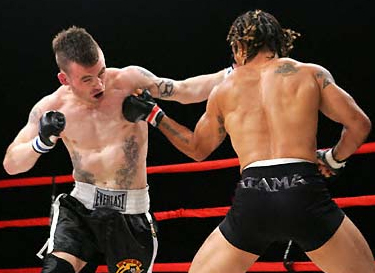  SHOOTO-RELATED LINKS: CURRENT SHOOTO
RANKINGS SHOOTO IN
NORTH & SOUTH AMERICA INTERNATIONAL
SHOOTO OTHER LINKS FOR MORE INFORMATION ABOUT THE SHOOTO AMERICAS DIVISION, COVERING NORTH, CENTRAL, AND SOUTH AMERICA, PLEASE DIRECT YOUR INQUIRIES TO THE U.S. SHOOTO COMMISSIONER, RICH SANTORO AT USASHOOTO@YAHOO.COM 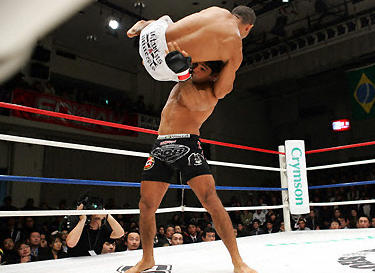 |